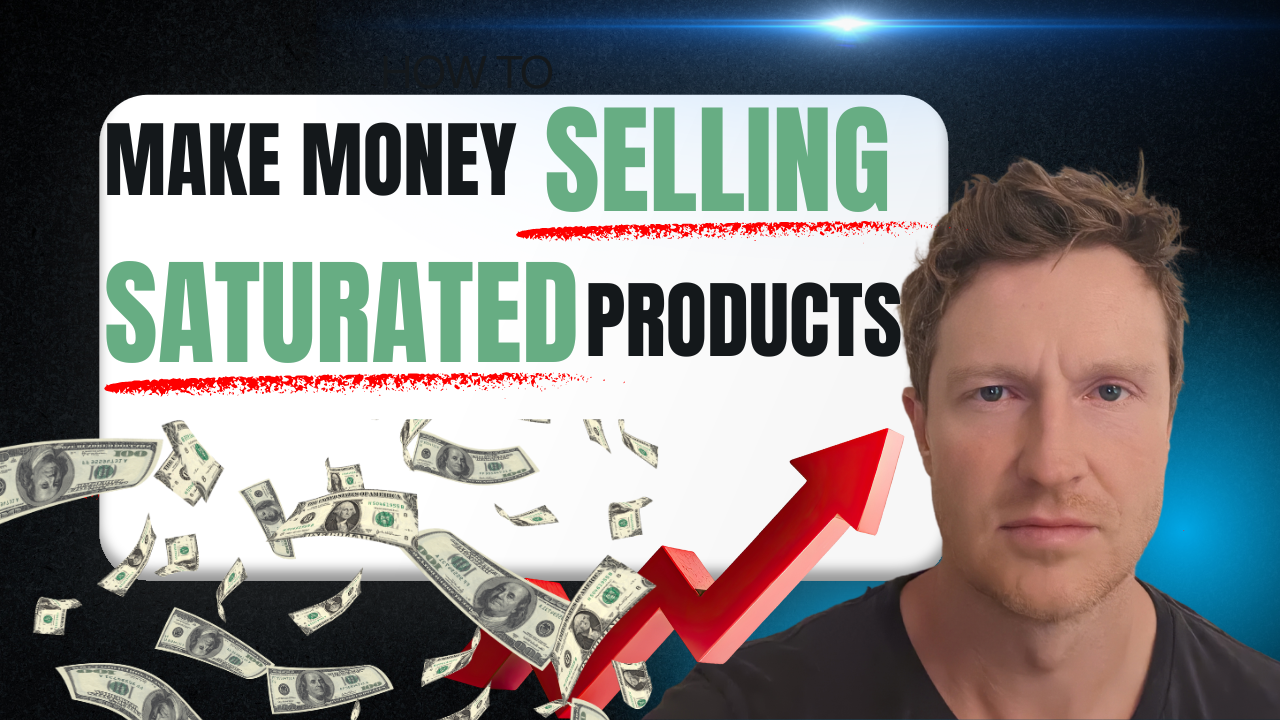
Most people avoid “saturated” products.
They assume that if a lot of stores are already selling something, then all the money has already been made. That the opportunity is gone. That they’ve “missed it.”
I used to think the same way.
But over time, I realised something that completely changed how I approach eCommerce, and it’s one of the main reasons I’ve been able to consistently make money in competitive markets.
Because the truth is, I’ve sold plenty of products that were already being sold by dozens (possibly hundreds) of other stores.
Same product.
Same suppliers.
Sometimes even the same price.
And yet… still profitable.
So what’s the difference?

Why “Saturation” Is Misunderstood
When people say a product is saturated, what they usually mean is:
“There are a lot of people selling this already.”
But that’s not necessarily a bad thing.
In fact, it can be a very good sign.
If multiple stores are successfully selling a product, it tells you:
- There’s proven demand
- The product solves a real problem or desire
- People are already willing to spend money on it
That’s validation, something most beginners struggle to find.
The real issue isn’t saturation.
It’s that most sellers approach these products in exactly the same way.
They use similar messaging.
They target the same audience.
They highlight the same benefits.
So they all end up blending in.
And when you blend in, the only way to compete is usually on price, which is exactly what you want to avoid.
The Strategy I Use That Changes Everything
Instead of trying to compete directly, I do something much simpler:
I change the angle.
That means I take the exact same product, but:
- Position it differently
- Highlight a different benefit
- Or target a completely different audience
This allows me to stand out without needing a new product.
More importantly, it lets me tap into people who may not have even considered buying that product before.
Because here’s something most people overlook:
People don’t ignore products because they’re bad.
They ignore them because the way they’re presented doesn’t resonate with them.
So when you change the angle, you’re not just tweaking your marketing — you’re changing how the product is perceived.

Simple Examples That Worked for Me
Some of the most effective angle changes I’ve used have been surprisingly simple.
For example, I used to sell pet products, and I noticed that certain items marketed for one type of animal could easily be repositioned for another.
There were backpacks designed for cats, the kind with the clear bubble window.
Instead of marketing them to cat owners like everyone else, I tested them with dog owners (specifically small dog owners).
Same product.
Different audience.
And it worked.
I did something similar with pet socks, originally sold for cats, but marketed toward dogs instead.
Again, nothing changed about the product itself. Only the way it was positioned.
That was a bit of a lightbulb moment for me.
Because it showed me that even small shifts in perspective can unlock completely new audiences.
A more conceptual example is something like a portable blender.
Most stores were marketing it as a convenient way to make smoothies on the go, targeting fitness-focused individuals.
But there are other ways to frame that same product.
For example:
- Parents who want to make baby food while travelling
- Busy professionals who want quick meal prep
- People focused on portion control or weight loss
Each of these is a different angle — and each appeals to a different group of people.
How to Apply This to Your Own Store
Once you understand this concept, you start to see opportunities everywhere.
Instead of asking:
“Is this product too saturated?”
Ask:
“Who else could this product be for — and why would they care?”
Here are a few practical ways to find new angles:
1. Change the audience
Think about different groups of people who could use the product.
For example:
- Different age groups
- Different lifestyles
- Specific niches or communities
Even narrowing down to something like a specific dog breed or type of customer can make your store feel more targeted and relevant.
2. Change the problem
Most products solve more than one problem — but most stores only focus on the obvious one.
If you can identify an alternative problem your product solves, you can position it in a completely new way.
For example:
- A dog bed isn’t just for sleeping
- It could be positioned for dogs with anxiety
- Or for joint support and recovery
- Or for older dogs needing extra comfort
Each of these appeals to a different motivation.
3. Change the outcome
Instead of focusing on features, think about the end result.
What does the product actually do for someone?
Take products like infrared sauna blankets or face masks.
They’re often marketed with a long list of benefits:
- Muscle recovery
- Better sleep
- Skin improvements
- Stress reduction
- Detoxing
But most customers are buying for one main reason.
If you build your store around that single outcome — for example, anti-aging or skin health — your messaging becomes far more powerful and specific.
Why This Works So Well
When you change the angle, everything else follows:
- Your product images
- Your product titles
- Your descriptions
- Your ads
- Your social proof
Your entire store becomes aligned around a specific message.
And that’s what makes you stand out.
You’re no longer just another store selling the same product.
You’re selling it for a different reason, to a different person, in a way that actually resonates.
Conclusion
You don’t need a unique product to succeed in dropshipping.
And you don’t need to avoid competition.
In many cases, competition is a good thing — it means the product works.
What matters is how you approach it.
Because when you stop competing on price and start competing on positioning, everything changes.
And once you start thinking in terms of angles, you’ll realise that most products have far more potential than they first appear.

Leave a Reply